Embodied Carbon Explained: Why Material Choice Matters
As Lowfield Timber Frames marks 25 years in the industry, our focus remains on building better for the future. The material decisions made at the earliest design stage play a crucial role in a building’s environmental footprint — with embodied carbon being one of the most significant considerations.
What Is Embodied Carbon?
Embodied carbon refers to the carbon dioxide (CO₂) emissions released during the production, transport, construction, and end-of-life stages of building materials.
Unlike operational carbon (the energy used to heat, cool, and run a building), embodied carbon is locked into the materials themselves.
As buildings become more energy efficient, embodied carbon can account for up to 50% of a building’s lifetime emissions. That’s why choosing sustainable materials has never been more important.
Why Timber Is the Sustainable Choice
Timber is unique. As trees grow, they absorb and store carbon. When used in construction, that carbon stays locked into the timber for the life of the building.
By using timber frame construction, we can:
- Reduce embodied carbon on every project
- Support sustainable forestry for future generations
- Deliver buildings that are high-performing and low carbon
How Lowfield Timber Frames Reduces Embodied Carbon
At Lowfield, our closed-panel timber frame systems and Larsen truss solutions take sustainability even further.
- Precision offsite manufacturing reduces waste.
- Efficient transport and installation lower site emissions.
- Integrated insulation achieves high thermal performance with minimal environmental impact.
Factory-Fitted Insulation: Smarter, Lower Carbon
Another way we reduce embodied carbon is through factory-fitted insulation. By installing insulation directly into our timber frame systems during offsite manufacture, we:
- Eliminate the need for additional materials and packaging on site.
- Reduce site waste and associated transport emissions.
- Ensure consistent quality and airtightness, which leads to better long-term energy performance.
We use a range of sustainable insulation solutions, including Warmcel Cellulose Fibre (made from recycled newspaper), mineral wool, cellulose, wood fibre, and sheep’s wool. These natural and recycled materials not only deliver excellent thermal performance but also help store carbon within the building fabric, further reducing embodied carbon across the life of the structure.
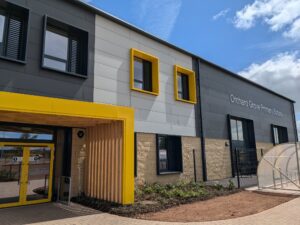
A clear demonstration of this approach is the CIW School project in Welshpool, where factory-fitted Warmcel insulation was integrated directly into the timber frame system. The project achieved a 0.25ach airtightness @ 50 pascals and a U-value of 0.10, built with solar panels on the roof.
This approach not only speeds up construction but also ensures every building we deliver achieves high thermal efficiency with the lowest possible carbon footprint.
Delivering Low-Carbon Buildings at Scale
At Lowfield, we’re not just talking about what’s possible — we’re already delivering low-embodied carbon buildings at scale. From schools to housing developments, our projects consistently prove that sustainable construction can be practical, efficient, and commercially viable.
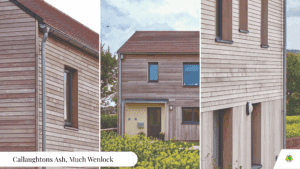
Award-nominated schemes such as Girton Almshouses and Callaughtons Ash are prime examples of how our timber frame systems achieve exceptional energy performance while reducing embodied carbon far beyond traditional methods.
Explore our Pavssiv Haus and Low Energy projects.
Our Long-Term Commitment
As part of our Carbon Reduction Plan, we are continually refining our systems and processes to lower the environmental cost of construction. For us, it’s not just about meeting regulations — it’s about leading the way in sustainable building.
By tackling both operational energy and material-related emissions, we are helping make Net Zero a realistic goal.
Choosing Lowfield Timber Frames means working with a partner that understands the importance of material choice, carbon reduction, and long-term building performance.
Looking to reduce embodied carbon in your next project? Contact the Lowfield Timber Frames team today to discuss how our timber frame systems can help you build better.